
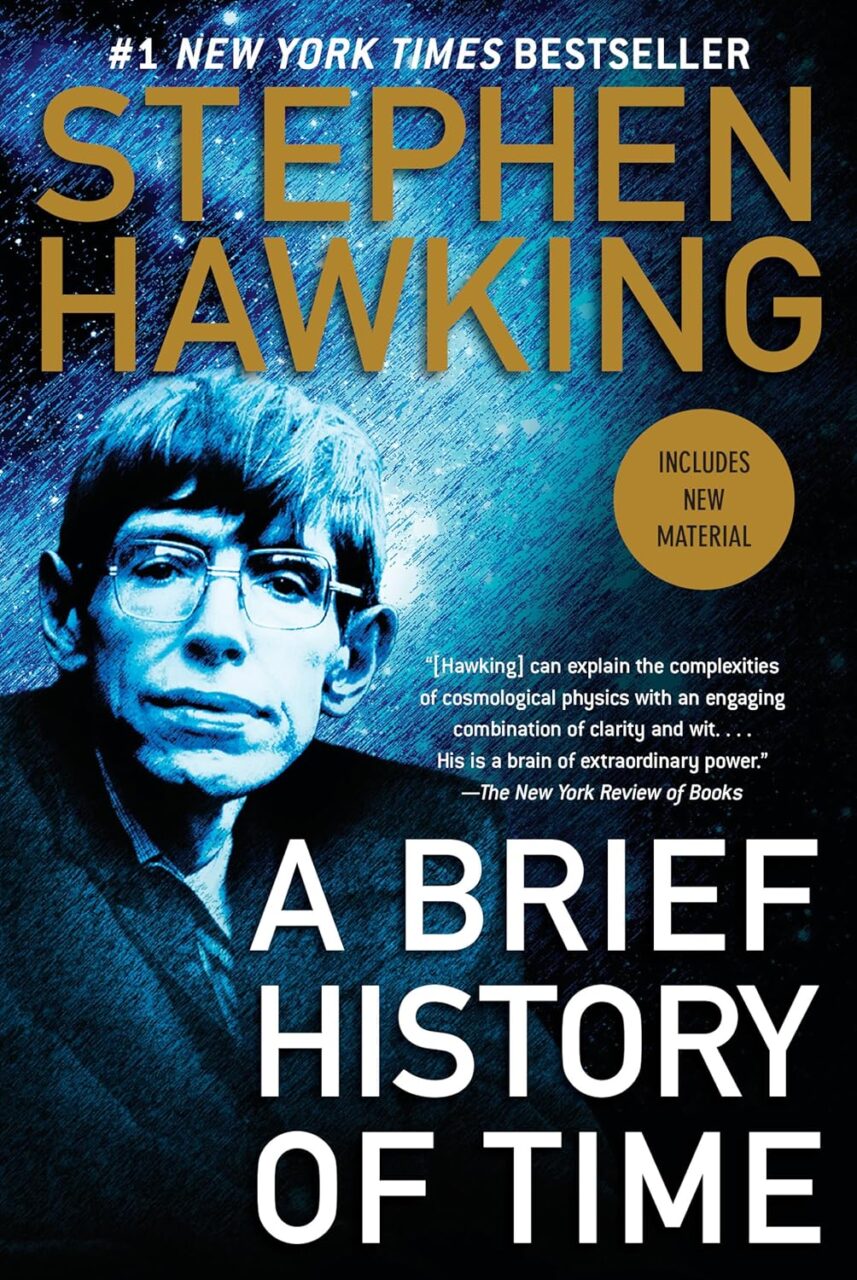



A Brief History of Time – Stephen Hawking
How did the universe begin, and how might it end? What is time, and why does it seem to flow only in one direction? Are there limits to what we can know about the cosmos? In A Brief History of Time: From the Big Bang to Black Holes, Stephen Hawking, one of the most famous physicists of the twentieth century, set out to answer these questions for general readers, and the result became one of the best-selling science books of all time.
Hawking begins with the history of our understanding of the universe, from ancient ideas about the Earth and the heavens to the discoveries of Copernicus, Galileo and Newton. He then explains the two great theories of modern physics: Einstein’s general theory of relativity, which describes gravity and the structure of space and time on the largest scales, and quantum mechanics, which governs the behavior of the smallest particles.
From there, he explores the expanding universe and the Big Bang, the nature of black holes, including his own discovery that black holes can emit radiation, the arrow of time, wormholes, elementary particles and the forces of nature. He also discusses the quest for a unified theory that would combine relativity and quantum mechanics, and what such a theory might reveal about the universe and our place in it.
Hawking famously included only one equation, Einstein’s E = mc², and wrote with clarity and wit. Some passages remain challenging, and science has advanced since publication.
A Brief History of Time is a landmark of popular science and an inspiring read for anyone curious about the cosmos.


Valoraciones
No hay valoraciones aún.