


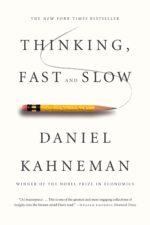

Thinking, Fast and Slow – Daniel Kahneman
Why do intelligent people make predictable mistakes? Why are we more afraid of losing a hundred dollars than happy about winning the same amount? Why do we trust our intuitions even when they are wrong? Daniel Kahneman, the psychologist who won the Nobel Prize in Economics for work done largely with his late collaborator Amos Tversky, answers these questions in Thinking, Fast and Slow, a landmark summary of decades of research on judgment and decision making.
Kahneman describes the mind as having two modes of thought. System 1 is fast, automatic, intuitive and effortless; it allows us to recognize faces, read emotions and react quickly. System 2 is slow, deliberate and effortful; it is needed for complex calculations and careful reasoning, but it is lazy and often accepts the quick answers System 1 provides. Many of our errors arise from this division of labor.
The book explores the heuristics and biases that shape our thinking, including anchoring, availability, overconfidence, the planning fallacy and the tendency to see patterns and causes where there are none. Kahneman explains prospect theory, which shows how people value gains and losses differently, and describes framing effects that cause us to make different choices depending on how options are presented. He also distinguishes between the experiencing self and the remembering self, and shows how this affects our judgments about happiness and well-being.
Rich in experiments and thought-provoking examples, Thinking, Fast and Slow is a demanding but rewarding read. Some studies it cites have since faced replication challenges, which the author himself acknowledged.


Valoraciones
No hay valoraciones aún.